
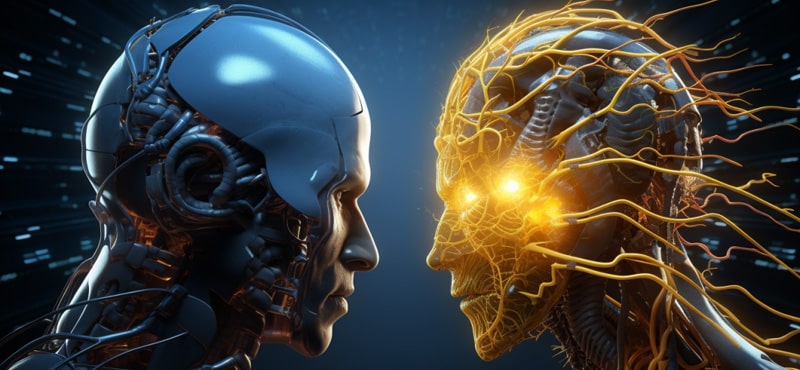
In case you haven’t noticed – the new marketing battlefield is invisible.
Algorithms wage silent wars for attention, optimizing against one another in endless loops of automation. On one side, AI-driven ad platforms constantly refine targeting, creative, and bidding strategies. On the other, consumers’ own algorithms, personalized feeds, filters, and recommendation engines, decide what actually gets through.
It’s AI versus AI, and the marketer is often just watching the machines duel.
When Every Message Is Machine-Made
In the past few years, I’ve watched marketing become an algorithmic ecosystem. A brand launches a campaign using an AI-powered platform to identify micro-audiences, adjust creative on the fly, and then fine-tune ad spend by the millisecond. Meanwhile, consumers live inside personalized bubbles shaped by their own AIs, voice assistants, news feeds, shopping algorithms, each curating what they see and hear.
Picture it: a brand’s AI generates ad variations in real time, while a consumer’s AI assistant quietly filters them out as “not relevant.” Two bots, neither human, silently negotiating whether the message gets through.
It’s the perfect marketing paradox: the more we automate, the less we connect.
Automation creates efficiency, but it also creates sameness. Everyone’s optimizing to the same data sets, the same signals, the same KPIs. Creativity gets compressed into patterns that machines know will “work.” And as those patterns multiply, differentiation fades. Human magic — the big idea, the story, the emotional spark — risks getting buried under layers of code.
Where Old-School Marketing Still Outplays the Machines
That’s where traditional marketing tradecraft re-enters the scene like an unexpected plot twist. The foundational principles of integrated marketing communications … clarity, consistency, cohesion … have never been more relevant.
Integrated marketing communications was built on the idea that a brand’s message should feel like a symphony, not a series of disconnected solos. Each channel, TV, print, digital, in-store, social, plays a different instrument, but the melody remains recognizable. That kind of unified storytelling creates emotional memory, the kind that no algorithm can fake.
AI can help us aim, but it can’t tell us why to aim in the first place. The why is still human territory. Positioning, storytelling, and brand promise remain the compass points that keep technology from spinning in circles.
Even the smartest AI can’t yet understand nuance, humor, or irony in a way that makes people feel something
And let’s be honest, even the smartest AI can’t yet understand nuance, humor, or irony in a way that makes people feel something. Great marketing doesn’t just land in your feed; it lands in your gut.
Blending Craft and Code
I would argue that marketing departments and agencies that combine traditional craft with intelligent use of AI hold the ultimate competitive advantage. They know that AI is not a shortcut, but a strategic amplifier. More importantly, they also know how to translate timeless marketing truths … audience insight, emotional connection, brand consistency … into data-informed action.
At Richard Allan, this is the way we use AI; to test creative hypotheses, not to replace them. We train algorithms to learn from human wisdom instead of generic Internet noise. And then we measure success not just in impressions or clicks, but in actual brand impact: awareness, loyalty, growth.
Think of it like jazz: our approach to AI for Marketing sets the rhythm, but we humans still improvise the melody. Machines handle the technical precision … the key changes, the timing, the repetition … but we’re the one who makes it swing.
In other words: we leverage AI for Marketing to serve the client’s mission.
The Future Belongs to the Hybrids
Soon, marketing won’t be about AI replacing people; it’ll be about people who understand AI replacing those who don’t. The best agencies, like Richard Allan, will operate like hybrid engines, powered by human creativity and machine precision in equal measures.
They’ll use AI for what it’s best at: automating, analyzing, and optimizing. And they’ll rely on human intuition for what it’s best at: inventing, empathizing, and inspiring.
We’re already seeing this hybrid mindset emerge. Smart creative teams are using AI to prototype campaign ideas faster, explore hundreds of visual directions, and test messages with simulated audiences, all before production. But the winning concepts still come from human insight: the shared cultural reference, the unexpected twist, the feeling that makes someone stop scrolling.
Because when every competitor has the same AI tools, the only true differentiator left is how creatively — and strategically — those tools are used.
Back to the Basics (with Smarter Tools)
The irony of the AI revolution is that it’s pushing marketing back to its roots. Success still depends on understanding people: their motivations, fears, and aspirations.
The best campaigns still start with a single clear idea that connects emotionally and lives consistently across channels.
AI may change how we execute, but not why we communicate. It’s still about brand trust. It’s still about relevance. It’s still about telling the right story at the right time in the right voice.
So yes, AI vs. AI is the battle raging in the background of modern marketing. But the real victory belongs to those who remember what the algorithms forget: that brands are built on human connection, not code.
And in that battle, strategy — timeless, human, and creative — still wins.