
I’ve spent a lot of time in SEO. Enough to know when something is just a repackaging … and when it forces you to change how you work.
AIEO (Artificial Intelligence Engine Optimization), also known as Generative Engine Optimization (GEO), is the latter.
After working hands-on with platforms like ChatGPT, Perplexity AI, and Claude, I don’t think the biggest shift is conceptual.
It’s practical.
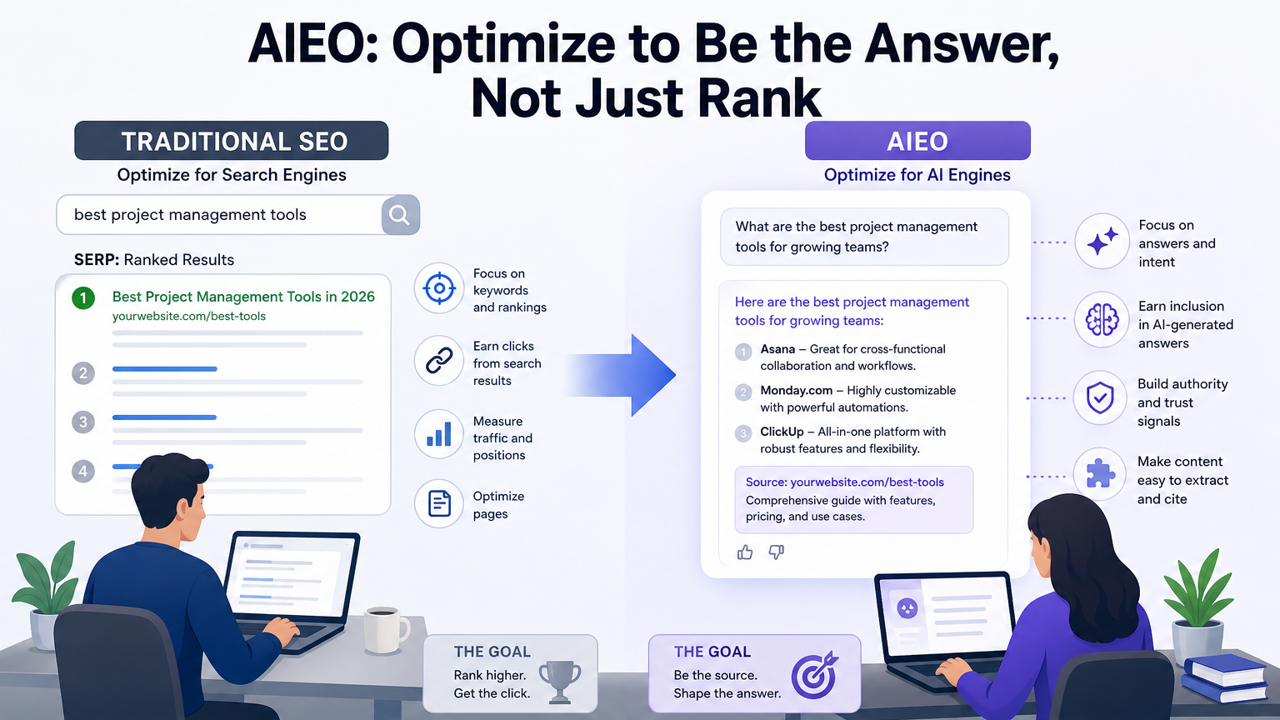
The question is no longer “how do I rank?”
It’s “how do I get used in the answer?”
And that requires different behaviors, not just different thinking.
First, the Reality Chec
Traditional SEO (largely shaped by Google) is built around:
- Ranking pages
- Driving clicks
- Measuring traffic
AIEO flips that:
- Your content gets extracted, not just visited
- Your brand may influence answers without a click
- Success is often invisible but compounding
That’s why a lot of teams feel stuck right now. They’re using SEO tactics to solve a different problem. So here’s what I’m actually changing in how I work.
Start Writing “Answer-First,” Not “Keyword-First”
Old habit:
Build a page around a keyword.
New requirement:
Build a page that fully answers a real question.
That means:
- Lead with the answer (don’t bury it)
- Use plain, direct language
- Resolve the question within the first few paragraphs
If an AI system can’t quickly identify:
- What question you’re answering
- What your answer is
…it’s unlikely to use your content.
Quick gut check: If someone copied just your first 150 words into an AI answer, would it stand on its own? If not, rewrite it.
Structure Content Like It’s Meant to Be Extracted
This is probably the most overlooked shift. AI doesn’t “read” your content like a human. It scans for usable pieces. So I’ve started treating content like modular building blocks:
- Clear H2s that state answers, not tease them
- Short, self-contained sections
- Bullet points that summarize key ideas
- Definitions that are explicit and standalone
Think: “Can this section be lifted and reused without additional context?” Because that’s exactly what’s happening.
Be Explicit About Entities (Not Just Topics)
This is a big one, and most marketers are underestimating it. AI systems look for clear signals of meaning, like:
- Company names
- Product names
- Defined concepts
- Specific terminology
Instead of vaguely saying:
“marketing automation tools”
I’ll write:
“Platforms like HubSpot or Marketo…”
Why? Because specificity increases confidence, and confidence increases the likelihood of inclusion.
Go Deeper on Fewer Topics
SEO trained us to scale content. AIEO rewards depth and consistency.
What I’m doing now:
- Fewer articles per topic
- More comprehensive coverage per article
- Strong internal linking between related pieces
The goal isn’t to “rank for everything.”
It’s to:
Become a trusted source on something.
That’s what AI systems are trying to identify.
Remove Fluff Ruthlessly
This one can be uncomfortable, especially for brand-heavy marketers. But here’s the reality: AI systems prefer content that is:
- Direct
- Clear
- Unambiguous
That means:
- Less storytelling (unless it adds clarity)
- Fewer vague claims
- More concrete explanations
If a sentence doesn’t add meaning, it reduces your chances of being used.
Add Data, Examples, and Specifics Wherever Possible
General content is easy to ignore. Specific content gets used.
Instead of: “This can improve performance.”
Say: “This increased conversion rates by 23% in X scenario.”
Instead of: “Many companies struggle with this.”
Say: “B2B SaaS teams with long sales cycles often see this issue during…”
Specificity does two things:
- Builds credibility
- Gives AI something concrete to extract
Think in Topic Systems, Not Isolated Posts
This is where AIEO really separates from traditional SEO. AI doesn’t evaluate just one page, it evaluates your body of work.
So I’m asking:
- Do we cover this topic from multiple angles?
- Are our viewpoints consistent?
- Do our pieces reinforce each other?
Because when they do, you stop looking like content … and start looking like a source of truth.
Actively Test Against AI Outputs
This is the most tactical shift, and honestly, the most eye-opening.
I regularly:
- Ask platforms like ChatGPT relevant questions
- See what sources and answers show up
- Compare that to our content
Questions I’m asking:
- Are we represented at all?
- If not, why not?
- What formats are being favored?
- How are competitors being used?
This is the closest thing we have right now to “AIEO analytics.”
What Not to Overthink (Yet)
A lot of teams are getting stuck trying to over-engineer this. Here’s what I’m not obsessing over (for now):
- Perfect attribution tracking
- “AI rankings” (they’re not stable)
- Replacing SEO entirely
SEO still matters. But AIEO is the layer on top that determines whether your content gets used in the first place.
The Bottom Line
AIEO isn’t about gaming a new system. It’s about aligning with how these systems already work. If I had to simplify it, it’s this:
- Make your content easy to understand
- Make your expertise obvious
- Make your information easy to reuse
Do those three things consistently, and you’re not just optimizing for AI … you’re becoming part of how answers get built. And that’s a much more durable advantage than ranking #1 ever was.